
If you’ve seen images of burning schools, burning trash cans and clashes between teenagers and police in Paris, I want to give you some context.
Because France is not burning. Paris is not burning.
There is currently a large protest movement among French high school students. And the reasons they are protesting are getting a little lost between dramatic images of fires and violence.
I’m not a journalist. I live in Paris, I’m a French citizen and I have two children in the French public school system.
I also went to the large demonstration at Place de la République in Paris myself.
Here’s what is actually happening.
Want to stay up to date with what’s happening in Paris? Join my newsletter for weekly Paris news, practical travel tips, upcoming events, and a little bit of everyday life in Paris, straight from someone who lives here. Get my weekly Paris updates →

Why are French high school students protesting?
In France, high school is called lycée. Students are usually between 15 and 18 years old.
Students have been blocking schools and demonstrating across France. Teachers, parents and other supporters have joined them.
The shortcut you often see online is simple: protesting kids are burning their schools.
In fact, most of them aren’t.
They are protesting about their learning conditions.
And a lot of what they are asking for is pretty basic.
69% of French public schools are more than 50 years old. Many have not undergone major renovations. Only a small percentage of school buildings are less than 20 years old.
Some schools are almost impossible to heat properly. There have been documented cases of classrooms at just 8°C (46°F) in winter. This has even happened in écoles maternelles, attended by children as young as three.
In summer, the problem reverses. Classrooms regularly exceed 30°C (86°F) during heatwaves. Some have reached 40°C (104°F) or more. One Paris school recorded 42°C (108°F).
Mold is a problem. A nationwide study found visible mold in at least 11% of the schools and nurseries studied.
Then there is asbestos. Around 82% of French school buildings were built before asbestos was banned in 1997. Around 70% of those older buildings contain asbestos.
Teachers are missing and often aren’t replaced. This can mean cancelled classes for weeks or even months. Sometimes students simply don’t have a particular subject because there is nobody available to teach it.
Even basic things aren’t always available. Students report broken or unusable toilets, missing soap and even no toilet paper.
And conditions aren’t the same everywhere. Buildings, staffing and resources can vary enormously depending on where a child goes to school and the resources available locally.

Then there is Parcoursup
If you’re not familiar with the French system, Parcoursup is the centralized platform students use to apply for university and other higher education programs.
Grades matter. Teacher evaluations matter. Your school record matters.
So imagine competing for the same university place as someone who had uninterrupted lessons all year, while you spent months without a teacher in one of your subjects.
That’s why this isn’t just about uncomfortable classrooms.
It can affect what happens next.
I have seen this myself
I have two children in the French public school system.
One of my sons currently doesn’t have English lessons because there is no teacher.
My other son went around half a school year without histoire-géo, history and geography, because his teacher was sick. There was no replacement.
At another point, there were no German lessons for half of the year because they couldn’t find a teacher.
A school my son attended was impossible to heat properly. 16°C (61°F) was the absolute maximum, and often it was colder.
These aren’t things I read about online.
This has been part of our own experience with public education in France.
And we don’t live in a socially disadvantaged commune. The school my kids attend is actually considered one of the better ones in our département.
And still, we face these issues.
So I can only imagine the problems some less privileged areas are facing.
And no, not every French school is like this. Of course not.
There are excellent public schools. There are well-maintained schools. There are places where most of these problems barely exist.
And that’s actually part of the issue.
Because another word matters enormously here.
Égalité.
You see Liberté, Égalité, Fraternité written on French town halls, schools and public buildings.
Equality isn’t just a nice idea here. It’s part of the national motto.
You can tell me schools have problems in your country too. I’m sure they do.
But that’s not really the point.
The question these students are asking is whether children in France are actually receiving equal opportunities.
And when one child has uninterrupted classes in a comfortable school while another spends months without a teacher, that is a fair question to ask.

But what about everything that’s burning?
This is probably what many people outside France are wondering.
Because those images are real.
Things are burning. People are getting hurt.
And there is a very easy conclusion to draw from them.
Look at these spoiled kids. They’re burning their own schools. Why should they get better schools if they’re destroying the ones they already have?
I fully understand that reaction.
But it’s also a shortcut.
The vast majority of students participating in this movement are not burning their schools.
The blockades themselves are often pretty simple, and the protests are intended to be peaceful. There are exceptions. Sadly, there always are.
Students put trash cans and other objects in front of the entrances. They stand outside their schools. They demonstrate.
At the end of the day, many put the trash cans back where they found them and leave.
But then there is another phenomenon in France that is important to understand.

Who are les casseurs?
France has what we call les casseurs.
The word roughly means “the breakers.”
They are people who appear mostly at the end of large demonstrations and gatherings and use them as an opportunity for confrontation and destruction.
If you followed the Gilets Jaunes protests, you probably saw them.
They also appear around major football matches and celebrations. Shop windows get smashed. Stores are looted. Trash cans and cars are burned. And, of course, there are confrontations with police.
This doesn’t mean every person committing violence right now is a casseur.
Nor does it mean no student has committed violence. Some certainly have.
But seeing a burning trash can doesn’t tell you who set it on fire.
And it doesn’t tell you what an entire protest movement stands for.
A peaceful demonstration involving thousands of teenagers singing, dancing and chanting will never travel around the internet as quickly as a photograph of something burning.
Add sensational headlines, social media algorithms and armies of internet bots flooding comment sections with hateful messages, and the picture can become very different from what is actually happening on the ground.
“They’re just thugs”
I’ve seen plenty of comments blaming people from the banlieues, immigrants and their children.
And here again, I think it’s worth resisting the easy answer.
You can condemn someone for smashing a shop window. I sure do.
And you can still ask why on earth they are doing it.
Those two things aren’t mutually exclusive.
Why does France repeatedly experience this kind of violence around demonstrations and major gatherings?
There isn’t one simple answer.
But if you start asking that question, you quickly encounter poverty, social inequality, segregation and a complicated relationship between certain communities and the French state. In both directions.
And if you keep going back, you eventually reach immigration and France’s colonial history.
France’s relationship with Algeria matters.
Colonialism matters.
Slavery matters.
The way the banlieues developed matters.
The relationship between some communities and the police matters.
None of that means colonialism made someone burn a trash can in Paris in 2026.
And none of it excuses violence.
Understanding something isn’t the same as justifying it.
And maybe it’s worth considering whether coming into central Paris and trashing luxury stores on the Champs-Élysées can sometimes be understood as a form of protest too.
That doesn’t make it right.
But saying “they’re just bad people” doesn’t help us understand very much.
And dismissing an entire student movement for better conditions because of violence committed partly by other groups doesn’t make much sense either.

And then there is the police response
This is the part I personally find particularly difficult.
Because these are school kids. Kids just like mine.
Many of them are minors and I saw them at the demonstration.
They’re standing there with their school backpacks and cardboard signs.
Opposite them are grown police officers in full riot gear.
There have also been serious concerns about the legality and proportionality of some of the tactics used against these teenagers.
And yes, there has been violence against police too.
Police officers have been injured. Things have been thrown at them.
I don’t want to pretend otherwise.
But the response against these teenagers has also raised serious concerns.
There have been thousands of arrests. Many of those arrested are minors.
Young protesters have been seriously injured.
There are allegations of disproportionate police violence, and some cases are being investigated by the French police inspectorate.
Amnesty International has also publicly raised concerns about the use of force against young protesters and called for de-escalation.
And that’s difficult to watch.
Because whatever you think about demonstrations, blockades or French protest culture, we’re still talking about teenagers protesting about their education.
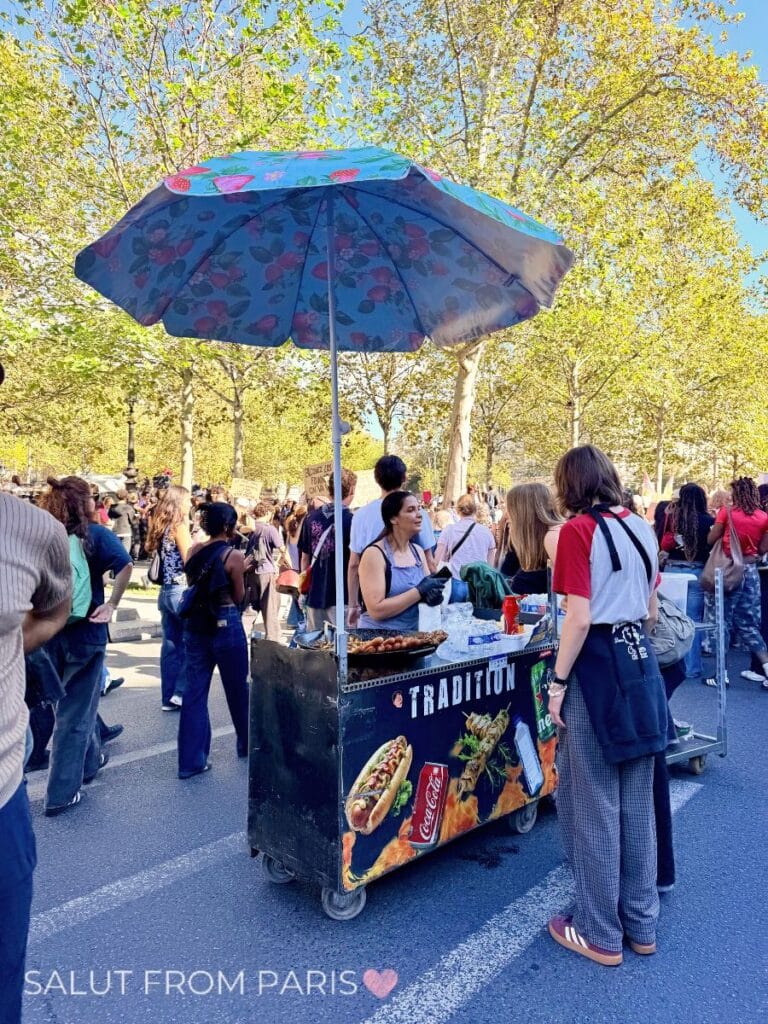
What I actually saw in Paris
I didn’t see Paris burning.
I saw teenagers.
I saw teachers.
I saw parents and families.
I saw older people.
And I saw ordinary people supporting kids who are asking for things that really shouldn’t be particularly radical.
Teachers in their classrooms.
Buildings where they can learn safely.
Basic facilities.
And a fair chance to prepare for whatever comes after high school.
You can disagree with the blockades.
You can condemn the violence.
You can think French protest culture is strange. Sometimes I do too.
But I think these kids deserve for us to understand what they’re actually asking for before reducing them to a photograph of a burning trash can.
Because behind all of this is a fairly simple question.
If égalité is one of the fundamental promises of France, shouldn’t it start in the classroom?

What does this mean if you’re visiting Paris?
This is also something I want to make clear, especially because many of my readers are planning trips to Paris.
When you follow events through the media or social media, you see the dramatic images. Smoke. Burning trash cans. Clashes. Police in riot gear.
Those images are real. But what they don’t show you is how concentrated these events usually are.
The demonstration I attended yesterday took place at Place de la République and lasted around three hours. It was a very clearly defined area.
Streets around the demonstration route were closed to traffic. Metro stations along the route were closed for security reasons. Police were positioned at metro entrances and access to Place de la République itself was controlled.
You couldn’t really have wandered into the demonstration by accident.
And only a few streets away, life continued as usual.
Cafés were open. People were sitting on terraces. Shops were open. People were going to work, meeting friends and getting on with their day.
This is something that can be difficult to understand when you’re watching from another country.
A photograph of something burning fills your entire screen. It can easily feel as if this is what Paris looks like at that moment.
It isn’t.
Large demonstrations in Paris also tend to follow specific routes and gather around places traditionally used for protests, such as République or Nation. They don’t suddenly happen all over Paris.
You can be visiting the Eiffel Tower, walking through Montmartre, going to the Louvre or Musée d’Orsay, or having lunch in the Latin Quarter and notice absolutely nothing.
There are exceptions, of course. The Champs-Élysées, for example, can become a gathering point after major football matches or other big events.
But again, these are specific events in specific places. Parisians know this too and adjust accordingly.

Even my 18-year-old son, who loves football and is both curious and a teenager, wouldn’t head to the Champs-Élysées after a major Champions League match just to see what is happening.
You simply avoid an area when you know trouble might develop there.
For visitors, the practical consequences of a demonstration are much more likely to be a closed metro station, a bus diversion or a street you can’t cross than finding yourself unexpectedly in the middle of violent clashes.
I’ve been to many demonstrations in Paris over the years because I’m a politically engaged person. Not once have I accidentally found myself caught up in violence.
Paris is a huge city. A demonstration can be happening in one part of it while everyday life continues completely normally almost everywhere else.
So if you’re visiting Paris during a period of demonstrations, stay informed about where and when they are taking place. Avoid the immediate area if you don’t want to encounter them, and expect occasional transport disruptions.
But don’t look at an image taken in one specific street at one specific moment and assume it shows you what is happening across Paris.
It doesn’t.

One last thing
Most of these protesters are minors.
They can’t vote.
They have been asking for better conditions for years. Yet many of the problems remain. Some have become worse.
And this is also the generation that spent important years of their childhood and early teenage years living through the pandemic.
Schools closed. Lessons moved online. Education was improvised. Social lives disappeared almost overnight.
Now they are old enough to understand what is at stake for their future.
But most of them still aren’t old enough to vote.
So they are using one of the few ways they have to make themselves heard.
That doesn’t mean you have to agree with everything they do.
But before reducing them to the most dramatic image circulating online, I think they deserve for us to understand what they are actually asking for.
And if you know someone who is worried about what they are seeing from Paris right now, feel free to share this article with them.
Want to stay up to date with what’s happening in Paris? Join my newsletter for weekly Paris news, practical travel tips, upcoming events, and a little bit of everyday life in Paris, straight from someone who lives here. Get my weekly Paris updates →
À bientôt,
Lena

Parisienne since 2006 🇫🇷
Sharing Paris life, French culture, cafés, food & honest travel tips
Join me on Facebook for updates and news about Paris.
NEW: The Salut from Paris Travel Guide:


Must-Haves for Paris:
- eSim card to stay online while in Paris. I used Airalo for my travels.
- You likely need a travel adapter to plug your devices.
- Travel Insurance – if you don’t have one, VisitorsCoverage is a good option.
- If your flight is delayed or even canceled, use AirHelp to get compensation.
Tours & Attractions:
- I book tours & activities through Get Your Guide or Viator.
- Museum & Landmark tickets can be cheaper on the official page, but they are often sold out.
- I love the GoCity Travel Passes for easy planning
Flights & Transportation:
- I use Omio to compare flight fares & connections
- Airport transfers I book through Welcome Pickup
- For car rentals, I use AutoEurope. It’s easy to compare prices
- Train Tickets, you can book through Omio
- Here’s my Parisian Metro Guide
Accomodation:
- Hotels in Europe I mostly book through Booking.com (check reviews carefully)
- Vacation Rentals through Airbnb or VRBO